Showing posts with label Amendments. Show all posts

Saturday, September 13, 2008

3: Countdown to Constitution Day

Today's Topic: The 27th Amendment

27th Amendment: Congress must limit when and how much its members are paid. 1992.

On January 9, 2008, many elected federal employess got a 2.5% COLA (cost of living) increase. Their last raise was in January 2006.

Congress members annual salaries were raised from $165,200 to $169,300.

Associate Supreme Court Justices annual salaries were raised from $203,000 to $208,100.

Chief Justice John Robert's annual salary was raised from $212,100 to $217,400.

Vice-President Dick Cheney's annual salary was raised from $215,700 to $221,100.

President George W. Bush did not get a raise. The president's annual salary $400,000.

The Fair Labor Standards Act sets the federal minimum wage. The federal minimum wage will be raised from $6.55/hr (05/27/07) to $7.25/hr (07/24/09).

Some cities and states passed laws to make their local businesses pay their employees a higher local minimum wage to match the living expenses in their area. For example:
  • Workers in California are paid a minimum of $8.00/hr.
  • Workers in San Francisco are paid a minimum of $9.36/hr.
However, a living wage is the hourly wage that a person must earn to support his- or her-self by working full-time (2080 hours per year). For example:
  • A single adult need to make $12.10/hr to live in San Francisco. The amount needed rapidly rises with the inclusion of dependents.

ESLPodcast 106 - High School Jobs
I started the day after my 16th birthday, qualifying me for a slightly higher minimum wage.

VOANews: On the Job, at Minimum Wage
About three percent of American workers who are paid by the hour earn the lowest rate permitted by law.

See also:

Friday, September 12, 2008

4: Countdown to Constitution Day


Rock the Vote @ Sundance, 2008

26th Amendment: US citizens who are 18 years old or older have the right to vote. 1971.

VOANews: Nixon Promises to 'Bring the American People Together' After '68 Win
Richard Nixon lost the 1960 election to John Kennedy, but he was known for his ability to fight, to lose, and to keep trying. Those skills would soon be tested. Transcript

Rock the Vote
Rock the Vote’s mission is to engage and build the political power of young people.
Rock the Vote2008: YouTube

Thursday, September 11, 2008

5: Countdown to Constitution Day

President John Fitzgerald Kennedy
was suceeded by his Vice-President Lyndon Johnson

Today's Topic: The 25th Amendment

The 25th Amendment: If the president dies or cannot serve, the vice-president becomes president. If both die, the Speaker of the House becomes president. 1967.

VOANew: Making of a Nation: The Presidency of John Kennedy Begins With Great Energy, but Ends in Tragedy
He stood strong against the Soviet Union during the Cuban missile crisis, and proposed a law to guarantee equal treatment of blacks. Then came the gunshots in Dallas in November 22, 1963.

VOANEWS: Making of a Nation: Johnson Takes Over Presidency After Kennedy's Murder
Lyndon Johnson had a lot of political experience. He had been President Kennedy's vice president, and had served for many years in the Senate and House of Representatives.

Wednesday, September 10, 2008

6: Countdown to Constitution Day

Today's Topic:
The 24th Amendment

24th Amendment made it illegal to make a citizen pay a voting fee. It is illegal to make a citizen take a reading test to vote. The 24th Amendment (1964) and the Civil Rights Movement led by Rev. Dr. Martin Luther King, Jr. crushed Jim Crow laws which discriminated against African Americans.


Library of Congress: Poll Tax Abolished I
Library of Congress: Poll Tax Abolished II
Breaking News English - Rosa Parks (Oct 26, 2005)
Oct 26, 2005 ... He said she was a symbol of the civil rights movement. He also said: “Just by a simple act of sitting down she stood up for so many people.” ...

VOANEWS: Civil Rights Movement: In the '60s, a Struggle for Equality in US: Activists marched, held sit-in protests and led "freedom rides" to demand better treatment of black Americans. Martin Luther King Junior lived by the idea of nonviolence, but his murder led to riots in more than 100 cities.

Tuesday, September 9, 2008

Monday, September 8, 2008

8: Countdown to Constitution Day

President Franklin Delano Roosevelt
March 4, 1933 – April 12, 1945

Today's Topic: The 20th & 22nd Amendments

20th Amendment: The President used to be inaugurated in March. The inauguration was moved up to January, to stop "lame duck" government. FDR was the last president to be inaugurated in March. The 20th Amendment was added in 1933.

  • 96:83. In what month is the new President inaugurated?
22nd Amendment: The President cannot serve for more than two terms. FDR was elected to four terms as president and died in office. The 22nd Amendment was added in 1951.
  • 96:44. How many full terms can a President serve?
  • 100:26. We elect a President for how many years?
  • 100:80. Who was President during the Great Depression and World War II?

VOANews: 'Happy Days Are Here Again': FDR, One of America's Greatest PresidentsFranklin Delano Roosevelt served longer than any other U.S. president. With his New Deal, he led the nation through its worst economic crisis. And, until his death, he led America through World War Two.

English Test: Idioms--Cats, Dogs, and Ducks

Sunday, September 7, 2008

9: Countdown to Constitution Day


Today's Topic: The Nineteenth Amendment.

The Nineteenth Amendment gave suffrage (the right to vote) to women.

VOANews: Susan B. Anthony, 1820-1906: She Led the Fight to Gain Equal Rights for Women, Including the Right to Vote
The nineteenth amendment to the U.S. Constitution won final approval in 1920 but she did not live to see it. Transcript of radio broadcast: 14 June 2008

VOANews: Betty Friedan: A Leader in the Modern Women’s Rights Movement

The life story of the woman who helped start the National Organization for Women. Her 1963 work "The Feminine Mystique" has been called one of the most influential books of the twentieth century.

Other Interesting Websites

Saturday, September 6, 2008

10: Countdown to Constitution Day


Today's Topic: The 18th and 21st Amendments

18th Alcohol is illegal. (Prohibition). 1919.

21st Alcohol is legal. Each state can make laws about making, selling, and drinking alcohol. 1933.

The 18th Amendment was passed to protect the health and safety of the American people. Instead of preventing alcoholism, Prohibition contributed to the rise of organized crime. The 21st Amendment made the alcohol legal and controlled by many federal, state, and local laws.

Although a US citizen can vote at the age of 18 years, the legal drinking age can be older. In the State of California, a person must be 21 years old to drink alcohol.

On the N-400, and during the Citizenship interview, you will be asked:

The USCIS is not asking: Have you ever been drunk?

  • The USCIS is concerned that alcohol abuse prevents citizens from freely exercising the rights and responsibilities of citizenship.
  • Example: if a person is drunk when they vote, they cannot make a good decision.
  • Alcohol abuse can also lead to crimes such as drunk driving or maintaining a safe work place.

Here are some groups that help alcoholics and people affected by alcoholism:

  • Alcoholics Anonymous: is an informal meeting for recovering and recovered alcoholics.

  • Al-Anon/Alateen: Al-Anon is an informal meeting for friends and family members of alcoholics. Alateen is an informal for young adullts (12-24).

  • MADD Mothers Against Drunk Driving: is a group that works to stop drunk driving, supports those affected by drunk driving, and prevents underage drinking.

Friday, September 5, 2008

11: Countdown to Constitution Day

The US Senate in the Capitol

US Senators from the State of California:
Barbara Boxer and Dianne Feinstein

Today's Topic: The 17th Amendment

17th Amendment says that the people--not the state legislature--can elect US Senators.

Questions from the current USCIS History and Government test:
  • 96:22. What makes up Congress?
  • 96:25. How many Senators are there in Congress?
  • 96:26. For how long do we elect each Senator?
  • 96:27. Name two Senators from your state.
  • 96:47. Why are there 100 Senators in the United States Senate?
  • 96:84. How many times may a Senator or Congressman be re-elected?
Questions from the new USCIS History and Government test:
  • 100:16. Who makes federal laws?
  • 100:17. What are the two parts of the U.S. Congress?*
  • 100:18. How many U.S. Senators are there?
  • 100:19. We elect a U.S. Senator for how many years?
  • 100:20. Who is one of your state’s U.S. Senators?*
  • 100:24. Who does a U.S. Senator represent?
  • 100:55. What are two ways that Americans can participate in their democracy?

US Senate Website

Wiki Senate

Thursday, September 4, 2008

12: Countdown to Constitution Day

Too smal? Click the photo.

Today's Topic: The 16th Amendment

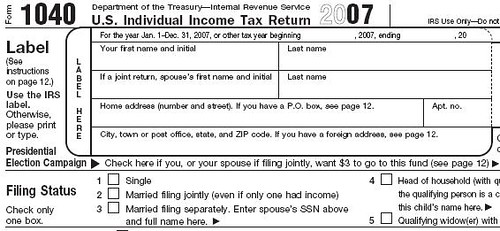
16th amendment says that Congress can tax income. The IRS (Internal Revenue Service) is the government that collects taxes. Every year on April 15th, millions of citizens and non-citizens fill-out the 1040 Federal Income Tax form and send it to the IRS on April 15th. People must send in 540 State Tax forms, too.

Compare the IRS 1040 to the USCIS N400. Both forms ask similar questions: name, address, marital status, etc. Furthermore, the N400 not only asks about job history (Part 6B), but also asks about income tax:

  • Part 10 A 5. Do you owe any Federal, state or local taxes that are overdue?
  • Part 10 C 13. Have you ever called yourself a ''nonresident'' on a Federal, state or local tax return?
  • Part 10 C 14. Have you ever failed to file a Federal, state or local tax return because you considered yourself to be a "nonresident"?

Did you know that the most important use of a social security number is to identity a tax payer? The SSN not only identifies you as a taxpayer on the 1040 & 540, the SSN appears on your other financial papers: W-2, W-4 form, paychecks, and bank statements.

It is very, very important to keep your SSN safe and guard against identity theft. It is very very, very important to pay taxes evey year to support your local, state, and federal government.

Wednesday, September 3, 2008

13: Countdown to Constitution Day

Today's Topic: The 15th Amendment

After the Civil War, the 15th Amendment gave the right to vote to all male US Citizens.

However, some communities refused to allow certain minorities to vote.

Women could not vote until the 19th Amendment (1920).

The Chinese Exclusion Act which took away the right to vote from US native-born citizens of Asian ancestry was repealed in 1943.

Jim Crow laws in the Southern United States which strongly discouraged African-Americans to vote was repealed by the 24th Amendment, 1964 & the Voting Rights Act 1965.

Here is a pdf of Voting Rights.

Here is a pdf of Voting Cloze Essay.

To read, listen, and watch more about the presidential election, go to VOANews USA Votes 2008.

Tuesday, September 2, 2008

14: Countdown to Constitution Day

The 14th Amendment defines the requrements for US Citizenship. Every person born in the United States is a citizen. An immigrant can become a naturalized citizen.

September 17th is Constitution Day and Citizenship Day. In preparation, here are some practice interviews for each part of the N-400.

Check out the National Constitution Center for more ideas about how to celebrate Constitution Day and Citizenship Day.

Monday, September 1, 2008

15: Countdown to Constitution Day


Labor Day Special

The US Citizenship Podcast Labor Day Special (MP3) features a story (PDF) about a retired couple, Mr & Mrs Hsun, exerpt of the work & travel sections of Mrs Hsun's interview, and a quick connection between the 13th Amendment and Labor Day.


Five Labor Leaders Who Improved Conditions for American Workers
In Honor of Labor Day, September 1, we tell about Samuel Gompers, John L. Lewis, Walter Reuther, A. Philip Randolph and Cesar Chavez. Transcript of radio broadcast: 31 August 2008
MP3 - Download (MP3)
MP3 - Listen to (MP3)
RealAudio - Download

Sunday, August 31, 2008

16: Countdown to the Constitution

Today's Topic: The Twelfth Amendment

The 12th amendment says that the President and Vice President are elected on a party ticket.


Saturday, August 30, 2008

17: Countdown to the Constitution


Today's Topics: the 9th, 10th, and 11th amendments

The 9th and 10th amendments limit the power of the federal govenment. On the other hand, the 11th amendment prohibits the citizens from suing another state in federal courts. (There are some exceptions).

The 9th amendment says that people have more rights not listed in the Constitution. The 9th amendment protects an individual's human rights (the right to food, housing, work, education, healthcare, a clean enviroment, etc).

The 10th amendment says that the States have more rights that are not already taken by the federal government. The 10th amendment gives states the power to organize state and local government.

The 11th amendment says that citizens cannot sue other states in federal courts because the citizen does not live in the other state and therefore is not subject to the other state's laws. (There are some exceptions).

For example:
  • Everyone in the US has the right to an education. People must know how to read and think so that they can make good decisions when they vote.
  • The state, county, and local goverments build and staff schools and libraries. People who study in the schools and libraries are able to particpate in the community to the the best of their ability.
  • Citizens who live outside the state of California cannot sue California about CA education laws.They cannot sue Califonia about the UC admissions policy, CAHSEE testing, bi-lingual education, or charter schools.

Friday, August 29, 2008

18: Countdown to the Constitution

Today's Topic: The Eighth Amendment

8th Amemdent: The government cannot demand excessive bail or fines, or any cruel and unusual punishment.

ESL Podcast 143 - Fighting a Parking Ticket
Eric: I'm going to traffic court. I got a parking ticket and I'm going to fight it. Mindy: How much was the fine?

ESL Podcast 172 - Legal Problems
When he was arraigned in court , the prosecutor said that the charges were very serious felonies and not simple misdemeanors.

More:

Thursday, August 28, 2008

19: Countdown to Constitution Day

Today's Topic: The 6th & 7th Amendments

6th A person has the right to a fair and speedy trial by a jury.

7th A person has the right to a jury trial for civil cases.

Every person has the right to a fair and speedy jury trial for civil cases. In order to protect this civil right, US citizens are called for jury duty.

Sometimes jury duty is inconvient, but serving on a jury guarantees that everyone is treated fairly and equally under the law. Serving on a jury is an important responsibility for each US citizen.

Wednesday, August 27, 2008

Tuesday, August 26, 2008

21: Countdown to Constitution Day

Today's Topic: The Fourth Amendment

The 4th Amendment protects people from illegal search and seizure. The government cannot arrest a person or search their property unless there is "probable cause."

It important to know your rights if you are stopped by the police. Knowing your rights will help you protect yourself. Knowing your rights will also help the police enforce the correct laws to keep the community safe.

ACLU: Know Your Rights:
What to Do If You Are Stopped by the Police
Know Your Rights Pocket Card (PDF)
Know Your Rights Pamphlet - English (PDF)
Know Your Rights Pamphlet - Spanish (PDF)
Know Your Rights Pamphlet - Farsi (PDF)
Know Your Rights Pamphlet - Arabic (PDF)
Know Your Rights Pamphlet - Hindi (PDF)
Know Your Rights Pamphlet - Punjabi (PDF)
Know Your Rights Pamphlet - Somali (PDF)
Know Your Rights Pamphlet - Urdu (PDF)

Comment added 08/28/08: Listen to ESLPod English Cafe 118 for a discussion about
  • The difference between seize, arrest, and detain
  • How to become the president of the United States.
N-400 Part 10 Section D 15-21 ask question about commiting a crime. Example:
  • Have you ever committed a crime?
  • Have you ever been arrested?
  • Have you ever been stopped by the police?
  • Have you ever been in jail or prison?
N-400 Part 10 Section D 22 A-G ask questions about commiting specific crimes. Example:

  • Have you ever been a habitual drunkard?
  • Have you ever sold or smuggle illegal drugs?
  • Have you ever gambled illegally?

N-400 Part 10 Section E 25-28 A-G ask questions about commiting deportation. Example:

  • Have you ever been deported?
If a person answers YES to any of the questions, even if he or she is innocent or the problem happened many years ago, the person must bring the court papers to the USCIS interview.

Can a person become a US citizen if they have been deported or committed a serious crime? Yes, but it is strongly advised to work with a good immigration lawyer to prepare the N-400.

Monday, August 25, 2008

22: Countdown to Constitution Day

Folk Hero Davy Crockett

Today's Topic: The Second and Third Amendments

The Second Amendment says:

A well regulated militia being necessary to the security of a free State, the right of the People to keep and bear arms shall not be infringed.

People interpret the Second Amendment in many ways. For example:
  • People can keep guns for personal protection.
  • People can keep guns only to protect the community (ex: police, national guard, army).
  • People can keep as many guns as they want for any reason.

There are many state and local laws that control the use of guns. For example:

  • In some cities or states, people must register their gun.
  • In some cities or states, people must have a special license to carry a gun.
  • People cannot bring a gun to public places, such as school, work, or government offices.
  • If a person uses a gun during a crime, the courts will add more time to the jail sentence.

The Third Amendment says:

No Soldier shall, in time of peace be quartered in any house, without the consent of the Owner, nor in time of war, but in a manner to be prescribed by law.

Before the American Revolutionary War, British soldiers took people's houses and lived in them. Because there has been no war since the Civil War in the United States, the government uses the Third Amendment as the constitutional basis for the right to privacy, or to own private property.

Some people think that the Third Amendment should be used as the constitutional basis of what a US soldier can and cannot do. The US Army, Navy, Air Force, and Marines, have their own rules and procedures which follow the US Constitution.


Protecting the United States is the duty of all US citizens!

Some people become eligible for US Citizenship based on their military service. On the N-400, they would check YES on Part 2 C and Part 10 Section F 29.

If a legal permanent resident is a male between the ages of 18-26, he must register for the Selective Service ("the draft"). If there is a national or international emergence, the goverment can call people to join the Armed Services. For more information, see N-400 Part 10 Section G or go to Selective Service System. Women do not have to register for the Selective Service.

During the USCIS interview, the officer will asks Part 10 Section H 37:

If the law requires it, are you willing to bear arms on behalf of the United States?

Some people are willing to carry a weapon--and possibly kill another person--to protect their country. They can check YES on questions N-400 Part 10 Section H 36, 37, 38, 39.

Other people, non-combatants, do not want to carry a weapon, but will support combatants. They can check NO on question 36 & 37, and YES on 38 & 39. During the Oath Ceremony, they will not take the full Oath of Allegiance--they will remain silent during the promise to "bear arms." Non-combatants fulfill their obigation of citizenship by helping to keep the United states safe and secure.

Some people belong to religions that do not let their people carry guns, support the army, or take oaths. They check NO on 36, 37, 38. These people can become citizens because they promise to obey the Constitution. and support the US government.

US Department of Defense: The Constitution

US Citizenship Podcast: The Military